Finding the Middle-Signal, Noise, and the Art of Recalibration
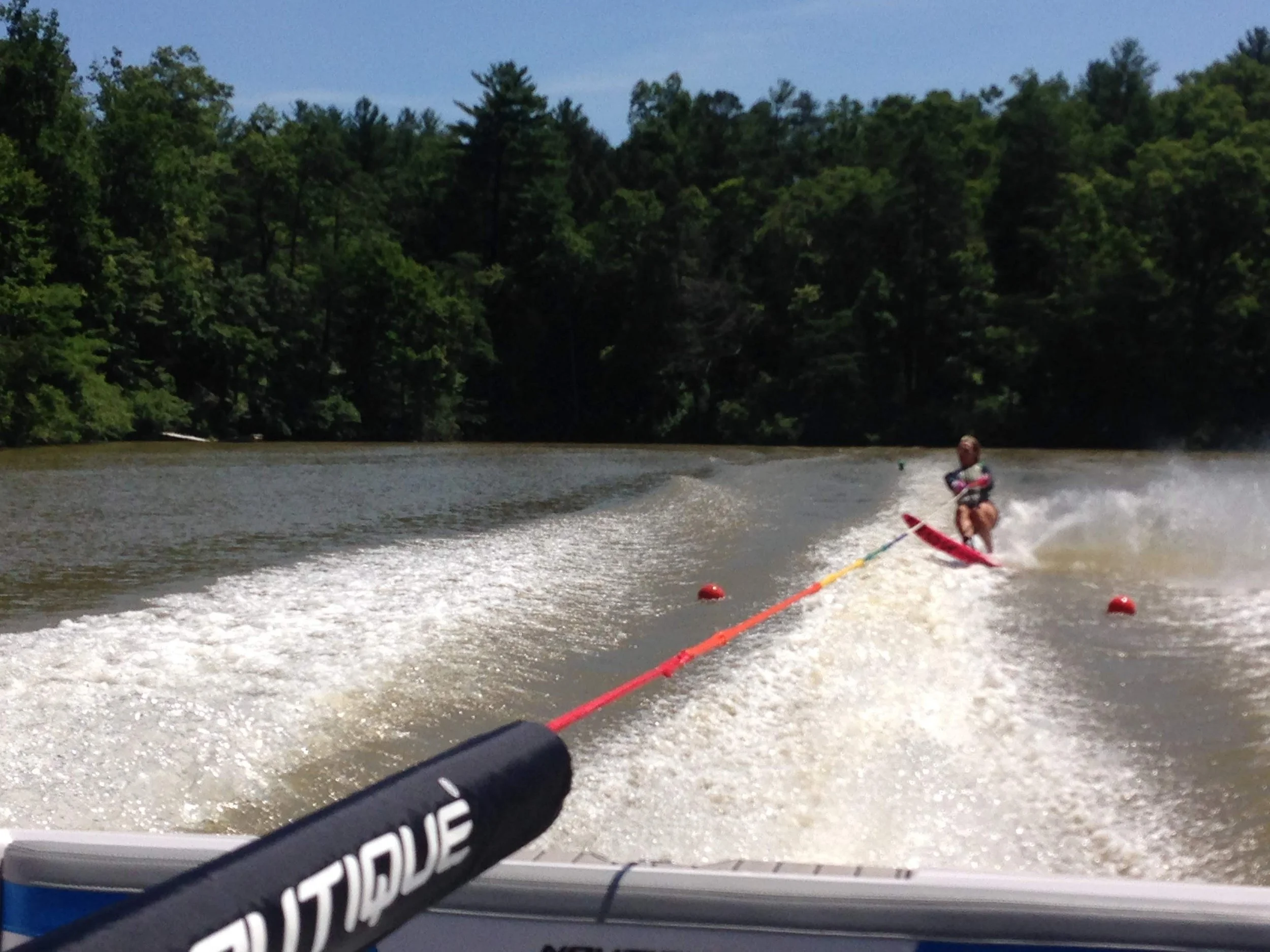
We just got Sure Path at Mystic Waters, and I immediately realized there were two ways I could look at it, one productive and one self-protective. Before I dive into those choices, what is Sure Path? It is a system to track the boat path for a tournament water ski boat. The idea is to drive straight down the middle, with minimal deviation, all while the skier puts significant pressure on the boat as they swing from side to side going around the buoys.
The parallel in cars is lane assist, where the car can keep you in the center of the lane. With Sure Path, it’s the driver’s job to stay in the middle; the tracking software tells you after the fact whether you stayed in tolerance or not.
For the last several years, most of my water ski driving is to pull Austin Abel, who is the pro that runs Abel Ski School. The critical point for him is that the driving he gets in practice is at the same standard he would get in a tournament. And how do they measure those standards in a tournament? With Sure Path. That’s why he decided to add it to his practice repertoire this year.
Nine years ago, when learning to drive at this level, I had several high-level drivers sit in the boat and give me pointers and feedback while pulling the skier. They were persnickety to say the least, and I had to develop thick skin to listen to the feedback and make corrections. The most difficult part for me was hearing that my boat path was not good enough when through my own senses – eyes, feel, touch – it seemed the best I could do. At first, I tried to explain or defend – “the skier pulled me off center”, or “I know I was in the right place” or “That felt like I caught him at just the right time.” The sensation of driving a skier going 36 MPH at short line lengths is reminiscent of the playground swing. There is the moment where you catch the momentum, and with your arms and legs you can swing ever higher. Or if you time it incorrectly, the swing sort of clunks and the momentum is lost. The driver and the skier dance this way together down the course, and the driver must keep the boat within a very tight tolerance down the middle, or the skier gets a reride.
I say all of that, because over the last several years, I have been driving without the benefit of any feedback other than what Austin could provide at the end of the lake. While a skier might be able to feel when the boat is really off, it’s almost impossible to give refined feedback from that vantage point.
Having little to no feedback is much like trying to wash a window in the dark. We believe it’s free of streaks until the light shines through. Feedback gives us no place to hide.
The first time we got in the boat with Sure Path, I felt the two choices staring me down. Would I be able to recalibrate my driving or would I get caught in trying to prove my driving was just fine? I have to say, the first couple of passes kind of stung. My boat path was not as good as I had believed. The first discovery was that I was chronically a little to the right. My senses had registered the middle slightly right of center. And that impacts the skier. The second discovery was that my timing was a little off when the skier crossed the center line. Indeed, I would let the boat drift slightly with the skier, again, which is not useful.
As Austin and I discussed the data and how I would make the corrections, I was reminded of a story in my book Dancing the Tightrope. The most annoying exercise that Bruce Anderson had me do was “Finding the Middle”. For the longest time, I saw it as a useless exercise designed to interfere with what it was I really wanted to do. In reality, the exercise turned out to be one of the most transformative lessons I learned: Finding the Middle discerns signal from noise. Everything starts with how you deal with the feeling of pressure.
Here’s an excerpt from the first time we did the exercise, where you will see how my frustration almost caused me to give up all together.
On this day, all I knew was that once again, we were doing Bruce’s maddening exercise called Finding the Middle. To me, it seemed like an unnecessary impediment, keeping me away from the work I came to do. How was this silly exercise going to help me with anything involving the horse? Nonetheless, I went along, because apparently the only way I would be able to do what I wanted was to humor him by Finding the Middle of the damn round pen.
His first step was to ask me to just go to the middle and find the closest approximation to the very center of the round pen. Once I did that, I just needed to make a mark in the dirt with my heel. I thought “OK, this won’t be so bad. Surely I can get close enough for him to let me move on.”
I walked into the middle, looked around a bit, made a tiny adjustment in my placement, and made the mark with my heel. As I was looking around, I had noticed one weird thing. The round pen didn’t exactly seem round. Oh well, this was close enough. I recalled that we did this the prior year and the whole process was rather elaborate. However, I had succeeded last year, so in my mind, that box was checked. I expected this time we would move through the Finding the Middle step very quickly.
Bruce asked me if my heel mark was on the middle. Thinking this would hurry things along, I gave him a smart-ass answer along the lines of, “It’s as close as I can get without a measuring tape.”
When working with a horse in a round pen or round corral, the human typically stands in the center and does different things to encourage the horse to move in circles around him or her. From the center and staying in a 6-to-8-foot diameter, the human can get the horse to walk, trot, or canter and, with the right moves, can get the horse to change direction. Knowing this, I was pretty sure a close approximation of the center was good enough to move to the next step. I was wrong.
“Well,” he said, “let’s go through a process that will get you closer.”
Dang it.
He handed me four blue flags and said, “Let’s start at the beginning.” Step by step, he guided me to first divide the round pen in half, and then half again. The clock in my head kept ticking, wondering if there was going to be any time left in our session to do what I came to do.
After going through the agonizing process of planting the four blue flags, we knew that if the division was accurate, we would be able to pull two strings from each point and the intersection would be the middle of the round pen. At this point, I still thought we were trying to find the actual middle of the round pen.
It would be many, many more sessions before I realized we were recalibrating me to find MY center.
So, after we found what we called the middle of the round pen – and after I was more than satisfied that we had the precise middle pinpointed enough for me to be able to move on, he gave me the orange flags.
Now this was starting to seem like an even bigger waste of time. I thought we were Finding the Middle and we had found the middle. My patience wearing thin, I took the flags, because I was pretty sure not taking them would make working with the horse take even longer than it already had.
He had me go stand next to one of the blue flags and look at the blue flag across from it to see if there was equal area on both sides of the imaginary line. I’m not big on rework — and this exercise felt like we were just redoing perfectly good work we had already done. Still, I humored him.
Then he asked me to do the unthinkable. He said take three steps to the right and evaluate the division of the round pen from my new vantage point. Why in the world would I do that?, I thought. He reminded me of my Negative/Positive Pole. He said I could also call it a “spirit level,” like the ones carpenters use. “That feeling of being off does not mean you have made a mistake! That feeling is your Negative/Positive Pole sending you signals that there is something for you to pay attention to or that is not beneficial to you!” But I don’t want to feel disequilibrium!
The feeling was exactly his point. He had to yell to raise the pressure enough to get me moving. He wanted me to move back and forth, forcing the internal bubble in my spirit level to move way out of center and then back again. “Now move back to center and then three steps to the left,” he said.
As I was standing three full steps from the blue flag, he asked me to feel my Negative/Positive Pole relative to whether there was half of the round pen on each side of me.
“Hell no!” I thought. Watching my reluctance to move even an inch, you would have thought there was a pit of alligators sitting there. Now he wanted me to feel it when every bone in my body was screaming to move me back to the comfort zone. Clearly, I wasn’t going to die if I pushed my bubble that far off center. But tell that to my body, where the sensations were screaming “Danger, danger!”
My Survival Mode and reality could not have been further apart. His tone of voice, intended to push my Negative Pole up, was doing its job. Every bone in my body remembered getting in trouble with my parents, my teachers, my bosses. The past came flooding in, warning me that when I feel this way, I better get in line, because I’m making a big mistake here unless I do what “they” say to do.
Bruce was pushing my “mistake button,” not to drive me crazy, but to heal me. He was intentionally setting the conditions for me to go into my old stories and the uncomfortable emotions, so that I could choose different actions than the ones I had programmed myself (or been programmed) to do. He said, “Give it a number on a scale of one to ten. How far off is it?”
With that distinction, the fog began to clear a little. I gave him a number – something like an eight or nine.
“Now go back to the right. Give me a number.” This time it was clearer that the blue flag across from me and my position did not represent a fifty/fifty split of the round pen. Now my number was more like a five.
The noise faded into the background and the inner electric charge became my primary focus. It was like a tuning fork, telling me which way to move.
“Move back and forth, paying no attention to the blue flag under your feet. Just keep moving back and forth until your poles are balanced. When your number is zero and the imaginary bubble within feels centered, plant the orange flag.”
As I followed his instructions, the external world dropped away. The only thing that mattered – for a brief, exquisite moment – was how I felt. Disequilibrium became my friend. Now my feelings were not telegraphing that I had made a mistake; instead, they were providing the warm voice of guidance.
Back and forth I walked, tuning in to the little electrical charge called my Pole, giving it a number as I made smaller and smaller swings. Finally, my Negative Pole balanced – the number was zero – and I planted the orange flag.
I mentally returned to the real world and noticed that my orange flag was a few inches from the blue flag.
It would be yet another year before I truly understood the depths of what had just happened, even though Bruce gave me the full lesson that day.
“The orange flag represents The You,” he explained, “not A you, the conditioning done by domestication. Domestication made you believe that’s who you are. It’s not. It’s so ingrained in you that every inch of your being believes it’s you. This exercise helps lift that veil. It allows you to consciously see the difference between A you and The You. When you are tempted to beat yourself up over making the mistake of planting one of the flags in the wrong place, remember, your inner guidance found the second place. Did you notice the voice in your head wondering what I was going to do with your mistake? Did you feel the urge to hit yourself with the 2x4 for getting it wrong? Do you really want to give your power over to those voices from your past? Are you really going to look outside yourself for approval and acceptance when you have this power within you? When you learn to use your Poles to guide you, it doesn’t really matter what ‘they’ say. When the chatter in your mind starts, all you have to do is listen to your Poles. The chatter won’t matter, because you will be tuning in to one of the Tools God gave you to guide you.”
That event happened seven years ago, and I’ve been Finding the Middle and recalibrating my Negative Positive Pole ever since. Every day I find a new way to recalibrate my internal guidance system. When flying airplanes, finding the middle looks like holding altitude and heading. The more tuned into the feedback from the instruments, the more subtle the corrections. When developing plans for our new house, finding the middle is imagining it this way, then that way, until suddenly it clicks. Now driving a ski boat, with the help of Sure Path software, I’m finding the middle again.
Remember those two choices I mentioned? One points to signal and the other to noise. Let’s take the noise side first. Years ago, I argued with a coach who told me to “get rid of my fear.” At the time, I could not articulate it well, but I was sure that there was a useful version of fear. He just kept telling me to get rid of my fear. It only made me feel more justified to ignore him. Now I recognize that he was telling me to get rid of the noise that fear produces. For example, my thoughts “Am I a good enough driver?” “What if I can’t get it?” “Why is this so hard?” And then there were all my explanations for why I was screwing it up. All noise.
What is the signal? When I get the feedback of where my boat path is, the question is the same as the flag in the round pen. The software gives me a number that tells me how far from center I was at each buoy. I can either use that number as a signal – I was too far right or too far left – or I can listen to the noise in my head. Do I need to move left or right? Do I need to hold more firmly, or give a little more? When my focus in the moment is tuning into my picture of going down the course and constantly recalibrating, there’s no room for noise in my head. I’m simply letting the boat, the ski course, and the software tell me where to be.
One of the key distinctions Bruce was trying to show me in the round pen was that I didn’t have to have all the answers, and I didn’t have to defend all my actions. All I had to do was listen to the feedback and let it tell me how to adjust. The feeling didn’t mean I was making a mistake; it was trying to guide me.
What freedom! It’s a very different way of moving through the world. I was a fan of feedback back then, but also sometimes struggled to receive it. What is notable now is the lack of noise when I get feedback that my boat path is off. I simply start making adjustments, and with that, my boat path is now well within tolerance, and my mind is quiet.
Given that outcome, this is going to sound counterintuitive, but what made the round pen exercise work was how much pressure Bruce had to apply to get me moving. If you had been watching from the outside, you would probably have wanted to jump to my rescue, even though I was not in any real danger. There were no alligators waiting to eat me. While I was flooded with emotion, which typically is thought to block learning, the magic happened because of the flooding, not in spite of it. I needed THAT MUCH pressure to get me past the stories, noise and old conditioning that I had to be perfect. He took me way past my edge and then showed me how to come back. In essence, the flooding flushed the nonsense out of my system. The process didn’t baby the noisy thoughts or give them any credibility. Instead, it gave me something useful to focus on: Give it a number. Then a question: How do you need to move to balance your poles? When I tried to go into my story, he just said: Which way makes your number go up? Which way makes it go down?
What a unique way to rewire the brain! I could actually USE the pressure of the moment coupled with a clear set of actions – give it a number, rock back and forth, let it tell you which way to move – to find the middle. And IN finding the middle, I systematically reduced the noise in my head.
Where are you finding your middle? In what ways are you finding yourself knocked off center? What strategies are you using to bring yourself back?